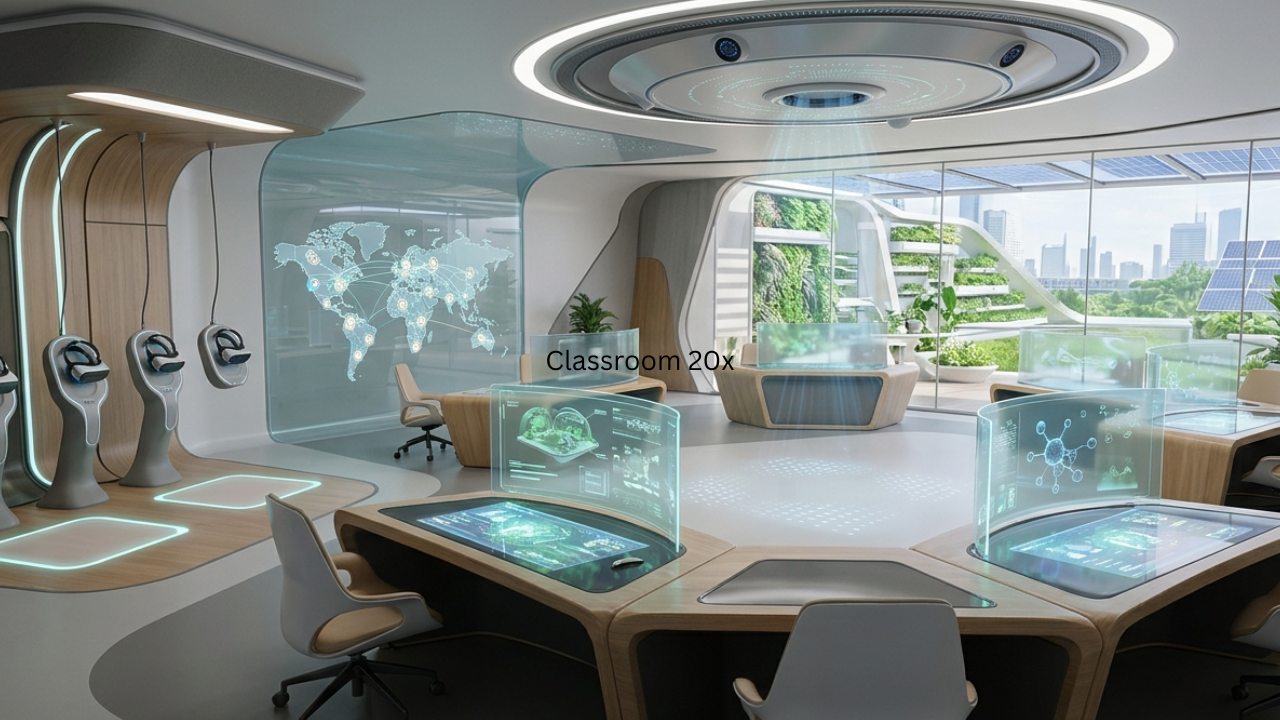
The traditional four-walled classroom, a model largely unchanged since the Industrial Revolution, is undergoing a radical metamorphosis. As we move deeper into the 2020s, the concept of Classroom 20x has emerged not just as a buzzword, but as a comprehensive framework for the next generation of pedagogy. This isn’t just about adding more iPads to a room; it is about a 20-fold increase in engagement, efficiency, and technological integration.
In this deep dive, we will explore what Classroom 20x actually means, the technologies driving this shift, and how educators can prepare for a landscape where the physical and digital worlds are indistinguishably blurred.
Defining Classroom 20x: More Than Just Digital Tools
To understand Classroom 20x, one must look beyond the hardware. Historically, “Classroom 1.0” was the chalkboard and lecture era. “Classroom 2.0” introduced the internet and basic 1-to-1 device ratios. Classroom 20x represents a leap into exponential learning environments.
The “20x” signifies a multiplication of impact. It suggests that through the strategic use of Artificial Intelligence (AI), Extended Reality (XR), and data analytics, a single educator can provide a level of personalization that previously would have required twenty different specialized tutors. It is an ecosystem where the environment itself becomes a silent teacher, responding to the student’s biometric feedback, cognitive load, and personal interests in real-time.
The Role of Artificial Intelligence in Classroom 20x
At the heart of the Classroom 20x movement is Artificial Intelligence. We are moving away from “one-size-fits-all” textbooks and toward dynamic, AI-driven curricula. In a Classroom 20x setup, AI doesn’t just grade multiple-choice tests; it analyzes the process of a student’s writing or problem-solving.
Imagine a student struggling with a complex physics equation. In a traditional setting, they might wait ten minutes for the teacher to become available. In a 20x environment, an AI co-pilot identifies the specific conceptual gap, perhaps a misunderstanding of torque, and immediately adjusts the lesson material to reinforce that specific pillar before moving forward. This “just-in-time” intervention ensures that no student is left behind while allowing advanced learners to accelerate at their own pace.
Extended Reality (XR) and Immersive Environments
One of the most visually striking elements of Classroom 20x is the integration of Extended Reality, which encompasses Virtual, Augmented, and Mixed Reality. Education is shifting from “learning about” to “experiencing.”
Instead of reading a chapter on the Roman Colosseum, students in a Classroom 20x setting can put on a lightweight headset and stand in the center of the arena, hearing the roar of the crowd and observing the architectural nuances firsthand. This immersive approach increases retention rates significantly because the brain processes these experiences as “memories” rather than just “information.”
Furthermore, AR allows for “layered learning.” A biology student can point a tablet at a physical plant in the classroom and see a digital overlay of its cellular respiration process in real-time. This bridge between the physical and digital makes abstract concepts tangible and exciting.

Data-Driven Personalization and Biometric Feedback
A controversial yet transformative aspect of Classroom 20x is the use of data. We aren’t just talking about test scores. Classroom 20x environments can utilize non-invasive biometric sensors, often built into wearable devices, to track a student’s focus and stress levels.
If the data shows that 70% of the class is experiencing high cognitive load or “brain fog” during a specific module, the system can alert the teacher to take a break or pivot the teaching style. This allows for a “human-centric” approach to data, where technology serves to protect the mental well-being of students rather than just tracking their output. It transforms the teacher from a lecturer into a “learning architect” who uses data to build better experiences.
The Shift from Consumption to Creation
For decades, students were primarily consumers of information. Classroom 20x flips this script. The modern classroom is equipped with “Maker Spaces” that utilize 3D printing, laser cutting, and no-code software platforms.
In this environment, a history project isn’t just a 5-page paper; it’s a 3D-printed replica of a historical artifact or a coded simulation of a historical event. By emphasizing creation, Classroom 20x prepares students for the modern workforce, where the ability to synthesize information and build something new is far more valuable than the ability to recall facts.
Redesigning the Physical Space for Flexibility
You cannot run a Classroom 20x program in a room with desks bolted to the floor. The physical architecture of these spaces is fluid. Furniture is modular, walls are often writable surfaces, and there are “zones” designed for different types of work.
- The Collaboration Zone: Large screens and circular seating for group brainstorming.
- The Deep Work Zone: Sound-dampened pods for focused, individual tasks.
- The Presentation Zone: Equipped with holographic displays or high-end projection for sharing ideas.
This flexibility acknowledges that learning is a multi-faceted process that requires different environments for different tasks.
The Changing Role of the Educator
Perhaps the biggest misconception about Classroom 20x is that it replaces the teacher. In reality, the teacher becomes more important than ever. With technology handling the “lower-order” tasks like grading and basic instruction, the teacher is free to focus on “higher-order” coaching.
In Classroom 20x, the teacher acts as a mentor, a facilitator of critical thinking, and an emotional support system. They help students navigate the ethics of AI, the validity of digital sources, and the nuances of human collaboration. The “20x” refers to the teacher’s ability to impact lives more deeply because they are no longer bogged down by administrative minutiae.
Challenges and Ethical Considerations
While the promise of Classroom 20x is immense, it is not without hurdles. The “Digital Divide” is a primary concern. If only elite schools can afford 20x technology, we risk widening the global inequality gap. For Classroom 20x to be successful, it must be scalable and accessible.
Privacy is another critical pillar. Collecting biometric and performance data requires rigorous ethical standards to ensure student information is never exploited. The goal is to use tech to empower the student, not to surveil them.
Preparing for the Classroom 20x Era
For schools and districts looking to move toward a 20x model, the transition should be incremental. It starts with professional development, training teachers not just to use tools, but to rethink their pedagogical approach.
Investing in high-speed infrastructure (like 6G or advanced Wi-Fi 7) is the foundation, followed by selecting software platforms that prioritize interoperability. The goal is a seamless ecosystem where the laptop, the VR headset, and the AI tutor all speak the same language.
The Long-Term Impact on Society
Classroom 20x is ultimately about preparing humanity for a future we cannot yet fully imagine. By fostering a generation that is comfortable with rapid technological change, fluent in data, and grounded in creative problem-solving, we are doing more than just “schooling.”
We are creating lifelong learners. In the world of Classroom 20x, graduation isn’t the end of education, it’s just the moment where the student takes their personalized learning ecosystem out into the professional world.
The classroom of the future is no longer a place you go; it’s a mindset and a toolkit that stays with you forever. As we embrace Classroom 20x, we aren’t just changing how we teach; we are changing how we think, grow, and connect in a digital age.
Also Read: Dead Outlaw Musical: The Bizarre True Story of Elmer McCurdy and Broadway’s Darkest Hit








One thought on “The Evolution of Learning: Why Classroom 20x is the Future of Education”
Comments are closed.