When you think of the “Wild West,” you likely imagine high-stakes shootouts, train robberies, and the dusty trails of Oklahoma. However, the most fascinating part of the story usually ends when the outlaw takes a bullet. In the case of the Dead Outlaw musical, the end of the life of Elmer McCurdy is only the first act. This critically acclaimed production, which transitioned from a smash-hit Off-Broadway run to the bright lights of the Longacre Theatre, has redefined what a “biographical musical” can be.
By blending dark humor, Americana-infused rock, and a plot so strange it has to be true, Dead Outlaw has captured the imagination of theatergoers and critics alike. If you are looking for a show that challenges the conventions of the genre while providing a deep, philosophical look at the American obsession with fame, this is the story you need to follow.
The True Story Behind the Dead Outlaw Musical
At the heart of the Dead Outlaw musical is the real-life story of Elmer McCurdy, a man whose “career” as a corpse was far more successful than his career as a criminal. Born in Maine in 1880, McCurdy was a drifter and a failed safecracker. His life of crime was largely a comedy of errors; he once used too much nitroglycerin on a safe, destroying the money he was trying to steal, and another time he accidentally robbed a passenger train instead of the payroll train he had targeted.
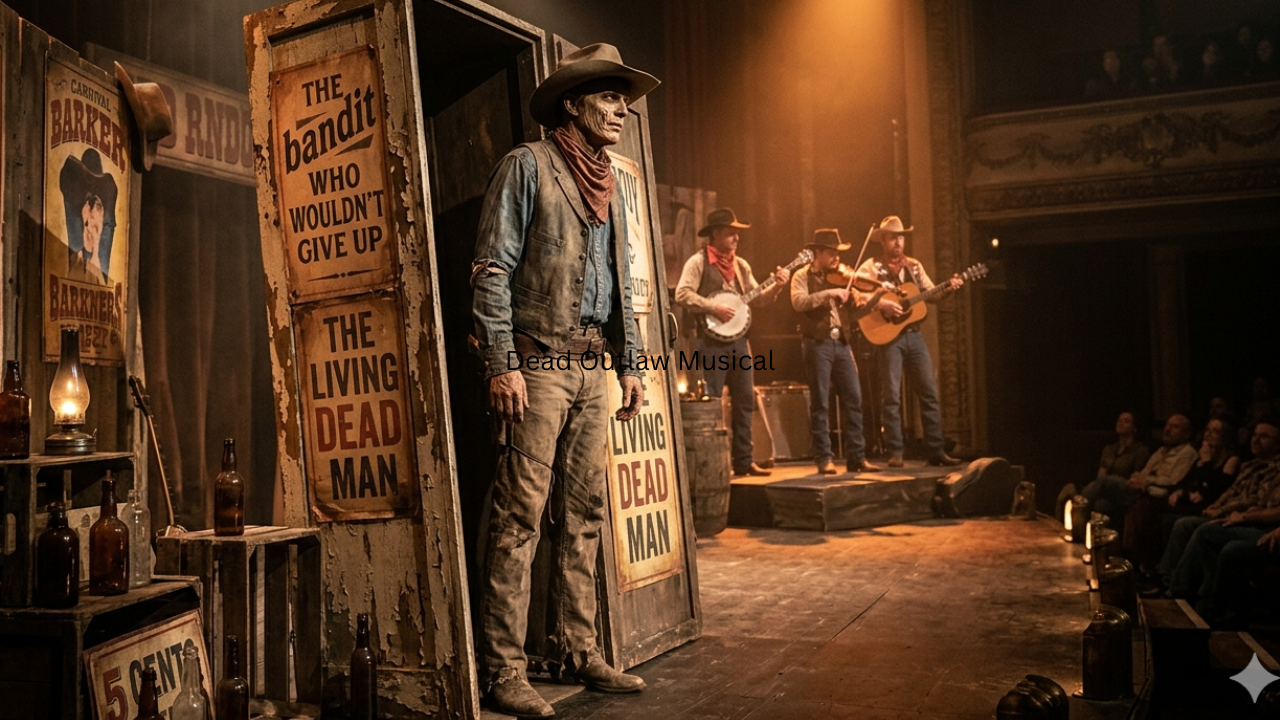
In 1911, McCurdy’s luck finally ran out during a shootout with a sheriff’s posse in Oklahoma. But because no one came to claim his body, the local undertaker decided to preserve him using an arsenic-based embalming fluid. Propping the corpse up in the corner of the funeral home, the undertaker began charging visitors a nickel to see “The Bandit Who Wouldn’t Give Up.”
For the next 60 years, McCurdy’s mummified remains traveled across the United States. He appeared in carnivals, sideshows, and even a haunted house in Long Beach, California, where he was spray-painted neon orange and hung from a noose. It wasn’t until 1976, during the filming of an episode of The Six Million Dollar Man, that a crew member discovered the “dummy” was actually a human being when its arm broke off. This macabre odyssey forms the backbone of the Dead Outlaw musical, exploring how a man who died in obscurity became a permanent fixture of American pop culture.
The Creative Genius: David Yazbek and Itamar Moses
The Dead Outlaw musical boasts a “dream team” of Broadway creators. It was conceived by David Yazbek, the Tony Award-winning composer behind The Band’s Visit and Dirty Rotten Scoundrels. Yazbek, who had been fascinated by the Elmer McCurdy story for over thirty years, teamed up with his Band’s Visit collaborator, book writer Itamar Moses, to bring this “arsenic-tinged” vision to life.
Unlike traditional Broadway scores that rely on sweeping orchestral ballads, the music in Dead Outlaw, co-written by Yazbek and Erik Della Penna, is a gritty, soulful blend of Outlaw Country, honky-tonk, and 1970s rock. The songs don’t just move the plot forward; they act as a commentary on the era, utilizing an onstage band that creates an intimate, “dive bar” atmosphere.
Directed by the visionary David Cromer, the production uses a minimalist yet highly effective staging. The set often transforms into a boxcar, a funeral home, or a carnival tent, mirroring the transient and often lonely life (and death) of the titular outlaw.
Andrew Durand and the Physical Feat of Playing a Corpse
One of the most talked-about aspects of the Dead Outlaw musical is the performance of Andrew Durand as Elmer McCurdy. Durand delivers a masterclass in duality. In the first half of the show, he portrays McCurdy as a volatile, whiskey-soaked dreamer, someone desperate to “be somebody” but lacking the talent to pull it off.
However, the real challenge begins after McCurdy is shot. For a significant portion of the show, Durand remains on stage as a corpse. Whether he is standing upright in a wooden coffin or being moved around like a piece of furniture by the other actors, his ability to remain perfectly still, unblinking, and devoid of “life” is a stunning physical feat. Critics have hailed this as one of the most unique performances in modern theater history, as he manages to remain the emotional center of the story without saying a word for the entire second act.

Themes of Fame, Failure, and the American Dream
While the premise of a “mummy musical” might seem like a gimmick, Dead Outlaw is a deeply philosophical piece of art. It tackles the dark side of the American Dream, the idea that even if you can’t achieve greatness through merit, you can achieve it through notoriety.
The musical asks uncomfortable questions about legacy:
- Is it better to be forgotten and at peace, or to be a “celebrity” who is exploited long after you have the power to object?
- Why is American culture so obsessed with the macabre and the “outlaw” archetype?
- At what point does a human being stop being a person and start being a product?
Through the character of the Bandleader (played with a wink and a sneer by Jeb Brown), the show serves as a “memento mori,” reminding the audience that “everybody dies,” but only a few end up as a neon-painted prop in a California funhouse.
Critical Reception and Award Season Success
From its very first preview, the Dead Outlaw musical was a critical darling. Before moving to Broadway, the production swept the 2024 Off-Broadway award circuit, winning:
- Drama Desk Award for Best New Musical
- New York Drama Critics’ Circle Award for Best Musical
- Outer Critics Circle Award for Best New Off-Broadway Musical
- Off-Broadway Alliance Award for Best New Musical
When it opened at the Longacre Theatre on Broadway in April 2025, the praise only intensified. Reviewers from The New York Times and Time Out New York praised its “darkly hilarious” tone and “rollicking” energy. While Broadway often favors safe revivals and movie adaptations, Dead Outlaw stood out as a beacon of originality, earning seven Tony Award nominations, including Best Musical and Best Actor for Andrew Durand.
Why Dead Outlaw is a Must-See for Modern Audiences
In an era of “cookie-cutter” entertainment, the Dead Outlaw musical offers something genuinely fresh. It isn’t just a history lesson; it’s a high-energy rock concert and a psychological drama rolled into one. It appeals to fans of true crime, American history, and unconventional storytelling.
The show’s ability to balance tone is its greatest strength. You will find yourself laughing at the absurdity of a coroner charging five cents for a peek at a dead man, only to feel a sudden wave of sadness for Elmer, a man who just wanted to signify something to the world and only succeeded once he was no longer in it.
The Legacy of the Dead Outlaw Musical
Though its commercial run on Broadway was relatively brief compared to long-running staples like Hamilton, the impact of Dead Outlaw remains significant. It proved that there is an appetite for “weird” theater and that a story about a mummified train robber could be just as moving as any classic tragedy.
For those who missed the live performance, the legacy of the show lives on through its cast recording and the upcoming Audible audio play. The story of Elmer McCurdy has survived for over a century, and thanks to this brilliant musical, he has finally found a way to “signify” that doesn’t involve being a sideshow attraction. He is now a part of Broadway legend.
Also Read: Dinituve: Revolutionizing Modern Digital Integration






One thought on “Dead Outlaw Musical: The Bizarre True Story of Elmer McCurdy and Broadway’s Darkest Hit”
Comments are closed.