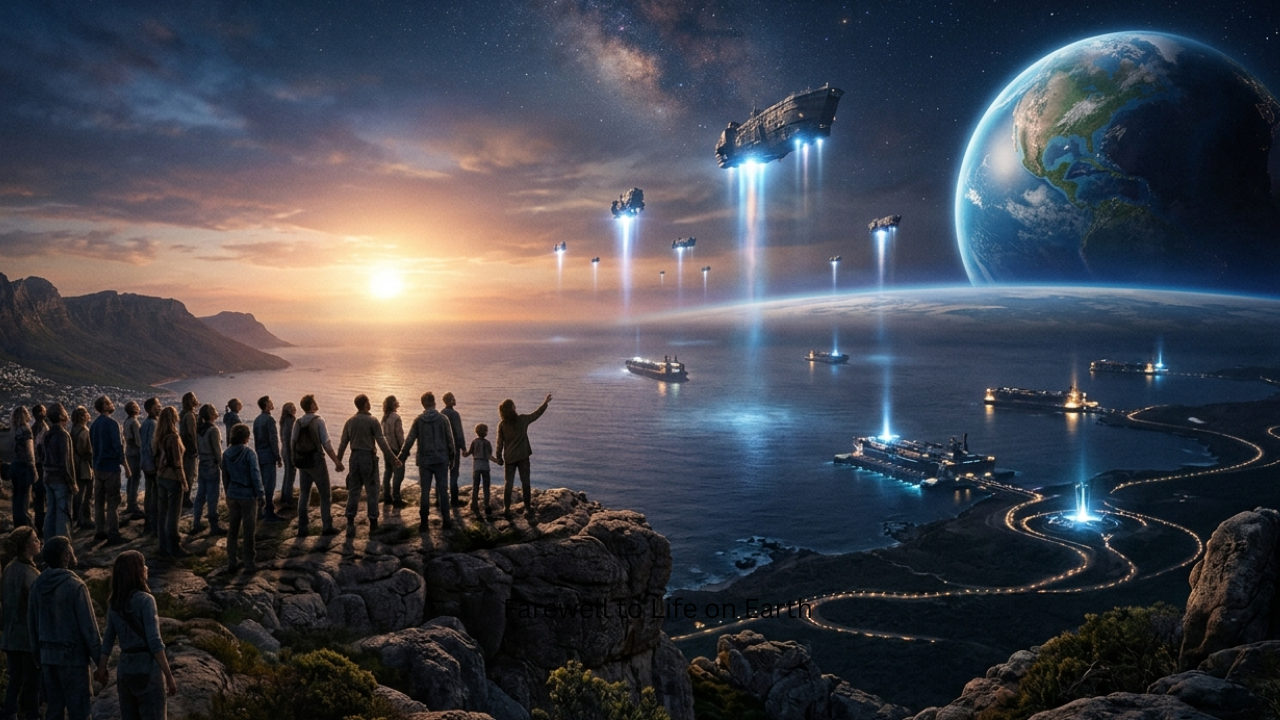
The concept of a farewell to life on Earth is one of the most profound subjects a human being can contemplate. It sits at the intersection of cutting-edge astrophysics, evolutionary biology, and deep existential philosophy. We might discuss the planet’s physical expiration due to solar evolution. Or we might consider a calculated human departure to the stars. The “farewell” represents a clear turning point in the story of consciousness. To understand what it means to leave our home, we must examine the biological, technological, and cosmic factors that will one day force us to say goodbye to the cradle of our species.
The Inevitable Solar Transformation
The primary reason a farewell to life on Earth is a scientific certainty lies in the life cycle of our star, the Sun. Currently, the Sun is a stable, middle-aged main-sequence star. However, it is constantly burning through its hydrogen fuel. In about five billion years, the Sun will exhaust its core hydrogen and start burning helium. It will then expand into a Red Giant. During this phase, it will probably engulf the inner planets, including Mercury and Venus. Earth itself could also be consumed.
Long before the Sun physically consumes the planet, the Sun’s luminosity will increase, making Earth uninhabitable. Scientists estimate that in about one billion years, the Sun’s heat will evaporate Earth’s oceans. This runaway greenhouse effect will strip moisture from the atmosphere. Photosynthesis will then become impossible, and the carbon cycle will end. For the biosphere, the farewell starts much sooner than the final solar expansion.
The Drive for Interstellar Migration
Faced with the eventual demise of our home planet, the conversation naturally shifts toward interstellar migration. If humanity or its evolutionary descendants wish to survive, a farewell to Earth becomes a strategic necessity rather than a tragic ending. This transition involves moving from a Type I civilization to a Type II or III on the Kardashev Scale, where we begin to harness the energy of our entire star system and eventually other stars.
The departure from Earth would be the greatest logistical undertaking in history. It would require the development of propulsion systems capable of reaching significant fractions of the speed of light, or perhaps the construction of massive generation ships with self-sustaining ecosystems where generations of humans live and die before reaching a distant habitable world. This phase of our history would redefine the “Earthling” identity, as we become a truly spacefaring species.

The Psychological Weight of Leaving Our Home
While the technical hurdles of leaving Earth are immense, the psychological and cultural impact is even more significant. Earth is not just a platform for life; it is the source of every myth, language, history, and emotion we have ever known. Saying farewell to Earth means leaving behind the only environment for which our biology is perfectly tuned.
The “Overview Effect,” described by astronauts as the profound shift in awareness experienced when viewing Earth from space, hints at the emotional complexity of a permanent departure. How does a culture maintain its connection to its roots when those roots are light-years away? The farewell would likely spark a global renaissance in art and literature, as we attempt to catalog and preserve the essence of “Earthness” before it fades into the cosmic rearview mirror.
The Evolution of Post-Earth Humanity
A farewell to life on Earth also means the end of human evolution. Earth’s gravity, atmosphere, and radiation protection have shaped our DNA for millions of years. Once we leave this protective bubble, our biology will change. This could happen through natural selection in low gravity or through intentional genetic and technological enhancement. The “humans” who live after Earth will likely be very different from us.
Transhumanism plays a big role in this change. We may find that merging with technology is the best way to survive in space. Silicon-based consciousness or digital uploads could handle deep space better than fragile carbon-based bodies. In this sense, the farewell to Earth is also a goodbye to the traditional human biological form.
Earth as a Relic and a Memory
In many speculative scenarios, Earth remains a protected relic long after most life has moved elsewhere. Imagine a future where the planet is treated as a vast museum or a biological preserve, a “cradle” that is visited by pilgrims from across the galaxy. This allows for a symbolic farewell rather than a total abandonment.
Yet, the laws of entropy and stellar evolution say that even a museum can close. The final farewell occurs when the last traces of human architecture, from the Great Pyramids to our modern ruins, are recycled into the atoms of a dying sun. This view humbles us and reminds us that our time here is a fleeting window in the cosmic timeline.
Ethical Considerations of Planetary Departure
As we consider leaving, we must face the ethics of a planetary farewell. Who gets to leave? If resources are scarce, does departure become an elitist escape, leaving most life to perish? An ethical farewell would need a global consensus and a drive to save as much of the biosphere as possible.
There is also the question of “planetary chauvinism,” the idea that we have a right to colonize other worlds just because our own is failing. As we prepare to say goodbye to Earth, we must ensure that we carry the lessons of our ecological mistakes with us, so that we do not simply repeat the cycle of destruction on a new world.
The Search for a New Eden
The search for exoplanets in the “Goldilocks Zone” is our first practical step. Telescopes are identifying worlds that could support liquid water and breathable air. Proxima Centauri b and the TRAPPIST-1 system are some of the candidates that fuel our imagination.
Finding a New Eden is more than finding a place to stand. It’s about finding somewhere life can restart. The farewell to Earth is eased by the hope that the “green” can be planted elsewhere. This transition means “seeding” the universe, with Earth as the original fruit whose seeds must grow after it withers.
The Spiritual Dimension of the Final Goodbye
For many, leaving Earth has a deep spiritual or religious meaning. It touches themes of transcendence and the afterlife. In many traditions, the physical Earth is a temporary test for the soul. From this view, departing from the physical world is the ultimate homecoming.
Even in a secular context, there is a sense of “cosmic spirituality” in knowing that the atoms that make up our bodies were forged in stars and will one day return to them. The farewell is not an end but a transformation: the return of our borrowed matter to the universe, to be used in the creation of new stars and perhaps new life forms.
Preparing the Digital Archive
Knowing that a farewell is approaching, humanity has already begun archiving its existence. Projects like the “Arch Mission Foundation” aim to store the sum of human knowledge on durable media that can survive for millions of years in space or on the lunar surface. This ensures that even after life on Earth has ceased, the memory of Earth remains.
Our digital footprints, music, scientific discoveries, and personal stories become the “luggage” we carry into the unknown. The farewell is more bearable because we will not be forgotten if we leave a clear signal of our presence.
The Legacy of the Blue Marble
Ultimately, the farewell to life on Earth serves as a powerful reminder of the value of the present moment. We live in a unique era when the planet is at its peak in terms of habitability and humanity is beginning to understand its place in the cosmos.
The “Farewell to Life on Earth” idea reminds us that nothing is permanent. Impermanence makes life beautiful. We witness Earth’s glory. Our duty is to cherish this home, protect its inhabitants, and prepare for whatever comes next in the universe’s story.
Also Read: The Ultimate Guide to the Guild of Handymen: Mastering the Art of Home Maintenance







One thought on “Farewell to Life on Earth: Exploring the Scientific and Philosophical Future of Humanity”
Comments are closed.